
 About
About MyInvest
My gift
Become permeable to relationships and connections
Everyone possesses a certain, incredible ability, but few recognize it in themselves or speak about it. Here, the same protective mechanisms operate as in dependencies: taboo, shame, lack of social acceptance, and to some extent guilt — since one "could" occupy oneself with something useful instead.
But what is more sensible than engaging with oneself and having the courage to share it?
This too forms part of the concept at a more advanced stage.
Beyond my operationalizable qualities — which, as shown in the mind-map, can be quantifiably surveyed — I'm occasionally asked what my gift is.
This question clearly targets my spirituality and isn't entirely simple to answer. Still, it's a valid part of my self-concept, which will gain certain relevance during our collaboration without needing to become significant for you.
I classify anything else clearly as conditioning or indoctrination, contradicting my neutrality precept and clashing with my ethical and moral notions of a knowledge alliance.
Personally, I practice what I call "secularized spirituality with epistemic drive" — a framework that seeks normative proximity to the natural sciences while acknowledging dimensions of human experience that rationalism alone cannot capture.
I accept and tolerate every form of religion, faith direction, alternative spiritual practice, and subculture, viewing them as approaches to understanding relationality and interconnection.
When seeking entry points to this framework, I find two approaches particularly useful:
Buddhism — Not as a belief system requiring faith, but as a philosophy of systems thinking. Rudimentarily, it emphasizes interdependence, cause-and-effect chains, and the relational nature of reality. It is, fundamentally, a path of self-knowledge through understanding how systems work.
The Aloha Spirit — A Hawaiian concept often misunderstood as emotional sentimentality. In reality, "Aloha" means "interconnected presence" — the recognition that all elements (thought, action, consequence, person, environment) exist in dynamic relation. This maps directly to what neuroscience now calls "embodied relationality" and "distributed cognition."
Both point to the same underlying principle:
.
Reality is fundamentally relational, not reducible to isolated rational units.
The Core Ability
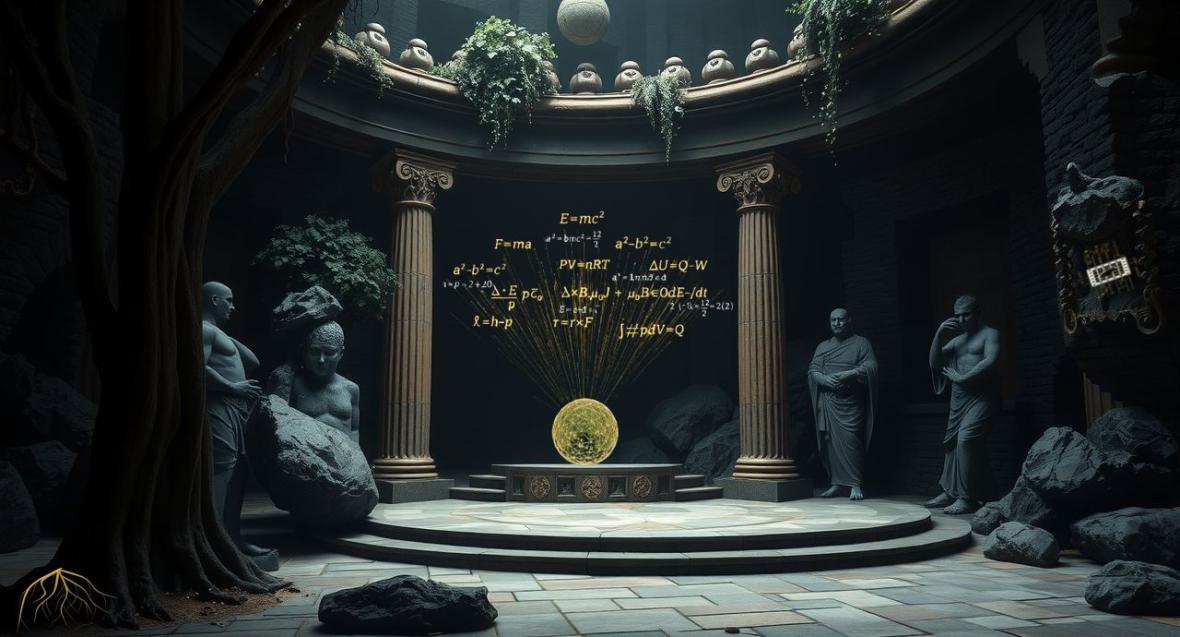
What I've developed over decades is the ability to recognize systemic completion patterns — to perceive how chains of causality converge toward particular outcomes before they fully manifest.
In neuroscientific terms: I engage in high-dimensional pattern-matching. My brain simultaneously processes multiple data streams — behavioral, temporal, spatial, kinesthetic, emotional signals — and matches them against decades of embedded patterns and precedents.
This is not prophecy. This is pattern recognition.
Think of it like chess: A grandmaster "knows" the optimal move before calculating it — not through magic, but through neural pattern-matching on millions of prior positions stored in memory. The answer emerges faster than conscious reasoning can articulate it. My cognitive process operates similarly, but across domains of human, organizational, and systemic behavior.
In formal terms: I recognize when current conditions match historical precedents that have well-defined convergence paths.
This ability proved remarkably useful during my time on the stock exchange. The rapid pattern-recognition that identifies convergence points in market systems is precisely the skill that separates successful traders from those who merely follow rules.
Later, during my years of alcohol dependency, this same ability became heavily distorted — clouded by substance-induced noise and impaired judgment. But with maturing consciousness and recovered clarity, it became ever more precise and reliable. Today I handle it with both precision and ethical restraint.
I recognize S-curve patterns: emergence → growth → maturation → decline.
This is logistic growth, not mystical prediction. Every system — biological, organizational, economic, neurological — follows this curve based on resource constraints and feedback loops. This is documented science.
When I observe initial conditions and system parameters, I can often perceive which phase the system occupies and where the convergence point lies. Again: pattern recognition grounded in systems theory, not prophecy.
My worldview treats reality as a probability landscape, not a deterministic mechanism. At any decision point, multiple futures are possible — but they are not equally possible. Constraint structures (neurobiology, economics, physics, relational dynamics) create likelihood distributions. This aligns with both quantum mechanics (superposition until measurement) and behavioral economics (utility functions create attractor states).
Here lies the paradox that defines my approach:
In my worldview, failure serves as the royal road to genuinely touching the truthfulness of being.
The moments we systematically devalue and stigmatize in our culture — failure, defeat, breakdown — are precisely where reality becomes visible. When systems collapse, when predictions fail, when we are forced to confront what actually is rather than what we believed — that is where genuine knowledge emerges.
This directly contradicts our sociocultural narratives of progress and certainty. Yet it is, I believe, exactly right.
In my immediate environment, this rapid pattern-generation is sometimes misinterpreted as procrastination or indecision. The reasoning: if one thought rapidly spawns many, creating a rich field of possibilities, there appears to be motionlessness.
Yet the opposite applies: Consider a spinning wheel. The faster it turns, the less it seems to move.
Rapid ideation is not paralysis — it is motion at a frequency that can appear static to slower observation.
Fundamentally, there is an obstructive aspect to this pattern-recognition: if something is truly worth my interest, I become highly enthusiastic very quickly. This combined with my loyalty creates a particular vulnerability — I forget space and time, hyperfocus on what engages me, and this regularly disadvantages me.
It costs me time, money, and credibility repeatedly.
Thus, for some time now, I've been deliberate in excluding this aspect from my business models. I deploy it carefully and selectively: in personal self-reflection, in implementation of isolated proprietary projects in finance and algorithmic programming, and in designing strategic interventions for clients.
I do not use these capabilities in ways that would constitute the "guru offering special insight" model. That contradicts everything I believe.
In our knowledge alliance, you'll perceive this aspect of my thinking whenever I pose questions that seem far afield from the immediate topic — questions that might appear tangential or nonsensical at first.
When this happens, please simply ask me. I will explain the pattern I'm seeing, the convergence point I'm tracking, the relational dynamic I'm noticing.
This is not mysticism. This is systems thinking made explicit.
For deeper context on how this fits into my broader philosophy:
→ See "A Tribute to Light" for why relationality matters, and how this pattern-recognition emerged through decades of cross-cultural learning.
→ See "Carved in Stone" for my foundational ethical principle: the only true spirituality is the incorruptibility of the self.
Not gifts, not special abilities — but integrity and authentic self-determination.
My gift is not mysterious or supernatural. It is a developed capacity for pattern recognition in complex systems, grounded in neuroscience, systems theory, and behavioral economics.
It is also deeply tied to my commitment to relationality — the recognition that all things exist in connection, that understanding requires seeing wholes rather than isolated parts.
And it is always, always constrained by ethics: I use this capacity only where it serves authentic liberation, never where it would create dependence or false authority.
That is my stance. That is my offer.